Sod choice is the single biggest maintenance decision you make when you put in a new lawn. The wrong grass on the wrong lot will cost you money in irrigation, fertilizer, pest treatments, and eventually replacement. The right grass on the right lot is much easier and can be less expensive to maintain.
Four warm-season grasses come up in almost every Cape Coral and Fort Myers conversation: St. Augustine, Zoysia, Bahia, and Bermuda. Each one has real strengths, real weaknesses, and a fairly narrow window where it is the correct call. Below is what UF/IFAS Extension research says about each, plus how those trade-offs shake out on typical Lee County residential lots.
If you want a broader look at what a new lawn install actually involves, our landscape installation page walks through the process.
St. Augustine
St. Augustine remains the most common residential lawn across South Florida. UF/IFAS describes it as a warm-season grass with wide, folded, coarse-textured blades and a medium-to-dark green color that spreads by aboveground stolons into a dense mat.
Sun and shade: it does best in full sun. Floratam needs at least 6 hours of daily sunlight, while newer cultivars like CitraBlue and Classic hold up better under partial shade.
Water: irrigate when leaf blades fold, wilt, or turn blue-gray, applying about 1/2 to 3/4 inch per event on an as-needed basis.
Salt tolerance: UF/IFAS lists St. Augustine as having relatively good salt tolerance and specifically names it (along with zoysia) as a homeowner-appropriate choice for coastal Florida sites subject to salt spray. It does not tolerate saltwater irrigation.
Wear tolerance: this is the honest weakness. UF/IFAS states plainly that St. Augustine has poor wear tolerance and does not hold up to repeated foot or vehicular traffic. If you have big dogs running the same path every day or kids in cleats, know that going in.
Pests: southern chinch bug is the major insect pest, and Floratam is especially vulnerable. Tropical sod webworm and armyworm show up on foliage. Gray leaf spot appears on new summer growth, and large patch disease is common in warm, humid weather, worse when you overdo nitrogen.
Cultivars you will see in SWFL:
- Floratam: the historic default. Coarse blade, needs full sun, prone to chinch bug.
- Palmetto: semi-dwarf, finer texture than Floratam, better partial-shade performance, mowed around 2.5 inches.
- CitraBlue: a UF release, blue-green color, denser habit, more drought tolerant than Floratam, Palmetto, or Raleigh in UF trials, with better gray leaf spot resistance.
- ProVista: a dwarfing, glyphosate-tolerant cultivar that cuts mowing frequency roughly in half versus other St. Augustines.
Best fit: full-to-mostly-full-sun front and back yards, HOA subdivisions where a uniform dense green look is expected, and coastal-adjacent properties exposed to salt spray but not saltwater irrigation. Watch for chinch bug pressure on Floratam in hot dry weather, and skip St. Augustine on true high-wear zones.
Zoysia
Zoysia is the premium alternative when a homeowner wants a finer texture and denser mat than St. Augustine, or better performance in mixed light. UF/IFAS describes it as a warm-season grass with dense growth that resists weed invasion, and blade textures ranging from fine (Zeon) to medium-coarse (Empire).
Sun and shade: good shade tolerance overall. Fine-textured cultivars like Zeon are more shade tolerant than Empire, which prefers full sun.
Water: it tolerates moderate drought and can go dormant within about a week under typical drought stress. Irrigation is 1/2 to 3/4 inch per event on an as-needed basis.
Salt tolerance: UF/IFAS names zoysia alongside St. Augustine as a homeowner-appropriate choice for coastal Florida sites subject to salt spray. It varies by cultivar. Manilagrass rates good to excellent, and Icon is rated very high.
Wear tolerance: better wear resistance than St. Augustine, although it recovers more slowly once damaged.
Pests: hunting billbug, mole cricket, white grub, and sod webworm. Large patch is the most troubling disease, especially entering and exiting dormancy.
Cultivars you will see in SWFL:
- Empire: UF/IFAS calls it the most common zoysiagrass in Florida. Prefers full sun.
- Zeon: fine-textured, good shade tolerance, premium look.
- Icon: Fine-textured with excellent color, strong salt tolerance, and good drought tolerance. Performs well in full sun and is a popular choice for homeowners looking for a dense, high-quality lawn.
Best fit: yards with mixed sun and partial shade, homeowners who want a finer manicured look, and areas that see more foot traffic than St. Augustine handles well. Watch for large patch during cool wet weather and slower recovery from damage than St. Augustine.
Bahia
Bahia is the low-input grass. UF/IFAS describes it as a deep-rooted warm-season grass suited to infertile sandy soils, forming an open canopy with visible seed heads through the growing season.
Sun and shade: it performs best in sun. UF/IFAS does not credit Bahia with strong shade tolerance.
Water: very drought tolerant. It survives extended dry periods by going dormant (browning) and greens back up with rain.
Wear and salt tolerance: not explicitly rated in the UF/IFAS bahia publication. If you are on a coastal salt-spray lot or a heavy-traffic zone, do not assume Bahia will handle it just because it is tough elsewhere.
Mowing: 3 to 4 inches during active growth, every 7 to 14 days. The seed head stalks grow fast and often push the mowing schedule tighter than that if you want the lawn to look tidy.
Fertilizer: low, about 1 to 2 lb of nitrogen per 1,000 sq ft per year, well below the other three grasses.
Pests: mole cricket is the most serious insect threat, feeding on the roots. Diseases are uncommon, with occasional dollar spot.
Cultivars you will see in SWFL:
- Argentine: denser sod, wider blades, darker green, uniform.
- Pensacola: narrower blades, extremely persistent, produces more seed.
Best fit: larger, sunny lots (rural Lehigh Acres, acreage in North Fort Myers) where the owner wants minimum irrigation and fertilizer and accepts a coarser, more open canopy with visible seed heads. Cosmetically it is not what most Cape Coral HOAs expect on a standard residential lot.
Bermuda
Bermuda is fine-textured, dense, medium-to-dark green, and spreads aggressively by rhizomes and stolons. UF/IFAS rates it as having excellent wear, drought, and salt tolerance. Those are real strengths, and they explain why Bermuda dominates golf tees, fairways, and athletic fields in Florida.
The reason Bermuda is uncommon in SWFL residential yards is not the grass, it is the maintenance regime it requires.
Sun and shade: poor shade tolerance. It needs full sun. TifGrand and Celebration handle partial shade slightly better than older cultivars but still need mostly sun. Most Lee County residential lots have some tree canopy, palm shade, or house shadow.
Mowing: UF/IFAS says 1 to 2 inches for low-to-moderate residential maintenance, which requires one to two mowings per week. High-maintenance settings drop to 1/2 inch but require a reel mower.
Fertilizer: 5 to 7 lb of nitrogen per 1,000 sq ft per year in South Florida, the highest of the four grasses in this comparison.
Spread: the same rhizomes and stolons that let Bermuda recover from wear also push it into flower beds and neighboring turf.
Pests: nematodes are the most serious pest. Mole crickets, sod webworms, dollar spot, and large patch also occur.
Cultivars you will see in SWFL:
- Celebration: more residential-friendly than older cultivars, can be mowed with a rotary at 1 to 2 inches, slightly better shade tolerance than other Bermudas.
- TifTuf: exceptional drought tolerance, retains color later into fall, mowed 0.5 to 1.5 inches.
Best fit: high-traffic areas that can be mowed frequently and short, coastal sites with heavy salt exposure and full sun, and homeowners who genuinely want a putting-green look and will maintain it accordingly. For a typical Cape Coral residential yard, the mowing frequency and full-sun requirement rule Bermuda out for most people.
At a glance
| Trait | St. Augustine | Zoysia | Bahia | Bermuda | |---|---|---|---|---| | Sun requirement | Full sun; Palmetto and CitraBlue tolerate partial shade | Full sun for Empire; Zeon handles more shade | Sun preferred | Full sun; poor shade tolerance | | Water needs | 1/2 to 3/4 inch as-needed | 1/2 to 3/4 inch as-needed; dormant under drought | Low; very drought tolerant | 1/2 to 3/4 inch as-needed; TifTuf highly drought tolerant | | Salt tolerance (UF/IFAS) | Relatively good; recommended for coastal residential | Recommended for coastal residential; varies by cultivar | No UF/IFAS rating in lawn publication | Excellent | | Wear tolerance (UF/IFAS) | Poor | Good, cultivar-dependent | No UF/IFAS rating in lawn publication | Excellent | | Mowing height | 3.5 to 4 inches standard; CitraBlue 2 to 3 | 1.75 to 2.5 inches typical | 3 to 4 inches | 1 to 2 inches; TifTuf 0.5 to 1.5 | | Mowing frequency | Weekly in season | Weekly | Every 7 to 14 days | 1 to 2 times per week | | Annual N (South FL, lb / 1,000 sq ft) | 4 to 6 | 2 to 4.5 | 1 to 2 | 5 to 7 | | Main pest concerns | Chinch bug, sod webworm, gray leaf spot, large patch | Large patch, billbug, mole cricket, sod webworm | Mole cricket | Nematodes, mole cricket, dollar spot, large patch | | Common SWFL cultivars | Floratam, Palmetto, CitraBlue, ProVista | Empire, Zeon, Innovation | Argentine, Pensacola | Celebration, TifTuf |
What we install most often
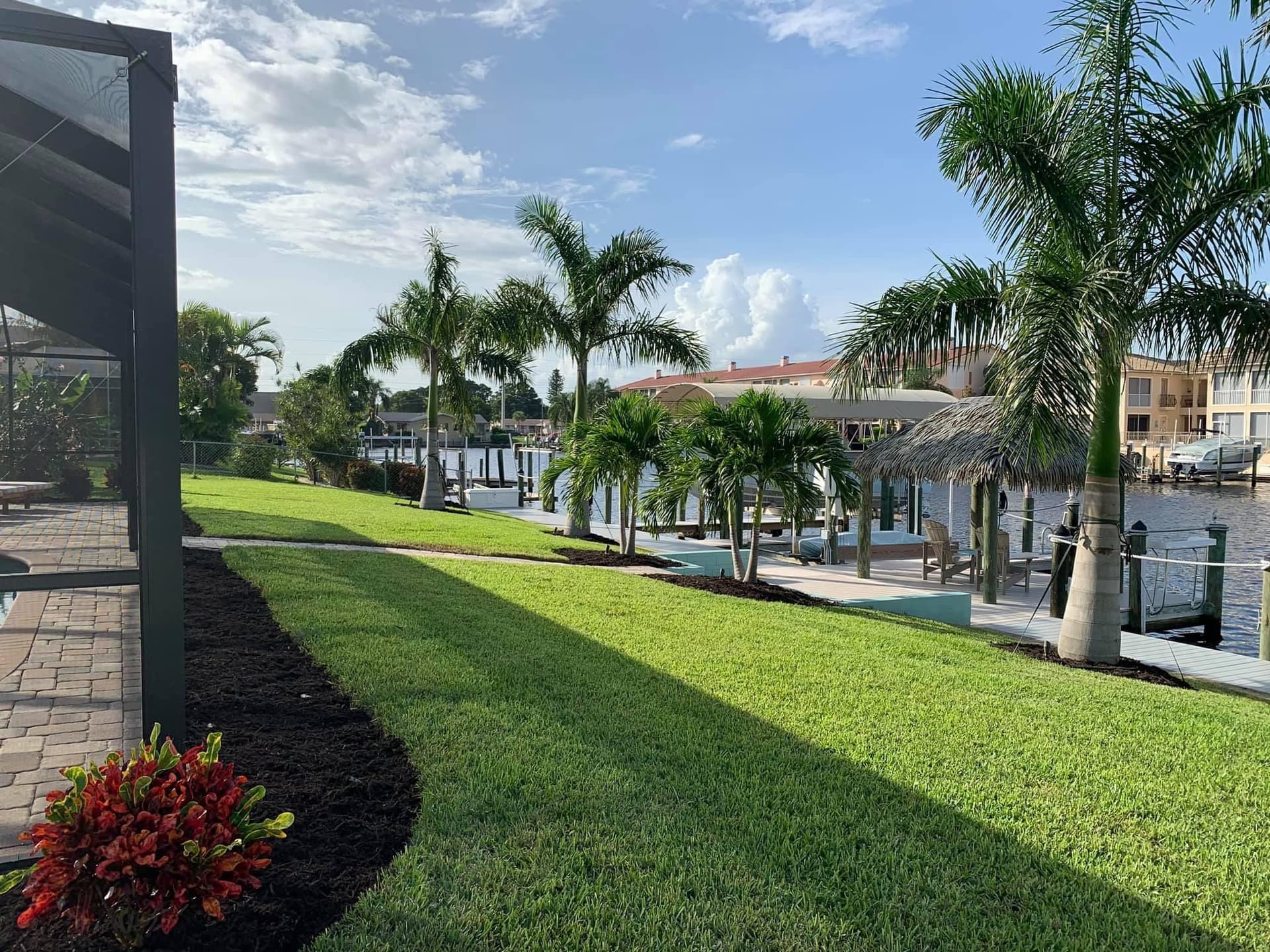
Danny Yates most often installs St. Augustine in Cape Coral. It fits the typical Lee County lot: enough sun for Floratam or Palmetto on most sides of the house, dense enough to crowd out weeds, salt-tolerant enough for canal-front and coastal-adjacent properties, and the look HOAs already expect.
Zoysia is the honest second choice, and the one to ask about when you want a finer texture, better wear tolerance for a busy back yard, or performance in mixed sun and partial shade. Empire in full sun, Zeon where the light drops off.
Bahia is the right call on larger sunny lots where the owner wants minimum inputs and does not mind the coarser look and visible seed heads. It is not the right call on a typical Cape Coral residential lot.
Bermuda is where you land when you are building a sports surface, not a front yard. If your project is a golf-style back yard, a batting or agility area, or an unshaded coastal site where wear is the deciding factor, it earns its place. Otherwise, the mowing frequency and fertilizer load make it a poor residential fit.
If you want help matching a grass to your lot and your maintenance appetite before you commit to a pallet, our landscape installation team walks the property, checks sun exposure, salt exposure, and traffic patterns, and gives you a straight recommendation.