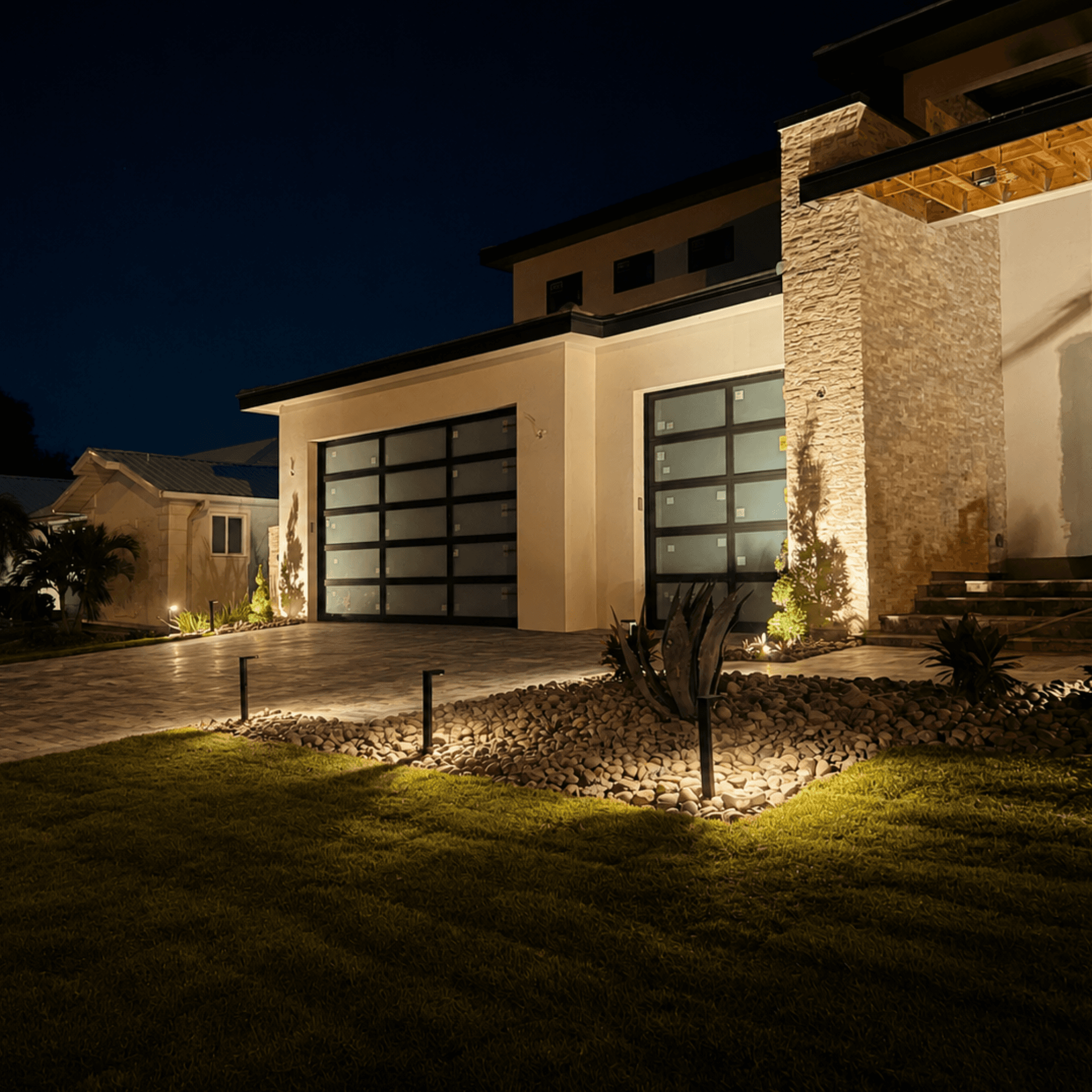
Good landscape lighting does three things for a Southwest Florida home. It keeps steps, walks, and grade changes safe after dark. It gives the front of the house a shape and a face at night, instead of a black rectangle behind a lit street. And it extends how long you actually use the yard, the lanai, and the pool deck, which is most of the reason you have them in the first place.
The trap most homeowners fall into is doing too much of it. Uplights on every tree, path fixtures marching down both sides of the walk, and a cool blue color temperature turn a garden into a parking lot at night. The goal is the opposite: a few clean focal points, low ambient light between them, and enough dark negative space that the focal points actually read.
Why 12-volt dominates residential
Almost every residential landscape lighting system in SWFL is 12-volt low voltage. A transformer plugs into an outdoor GFCI outlet and steps 120-volt line power down to 12 volts, which then runs out to the fixtures on low-voltage cable.
Two practical reasons this wins. First, safety. A nicked cable at 12 volts is not the shock hazard a nicked line-voltage cable is. Second, install. Low-voltage cable does not have to live inside buried conduit, and it does not usually require a licensed electrician. Line voltage still has its place for parking-lot poles and long commercial runs, but for a residential yard the 12-volt system is the standard for good reason.
LED versus halogen
Halogen ruled landscape lighting for decades. LED has replaced it for every reason that matters in Florida.
LEDs run cooler, draw a fraction of the power for the same brightness, and last many times longer before they need a bulb change. On a system that runs a few hours a night, that turns re-lamping from a scheduled chore into an occasional one-off. Lower wattage per fixture also means you can put more fixtures on a single transformer without pushing it, and heat management inside the fixture becomes far easier in a humid climate.
Color temperature is where LED design lives or dies. For residential work, specify 2700K warm white. It reads as inviting, flatters brick, stucco, wood, and skin tones, and matches the color memory people have of incandescent porch light. 3000K is a slightly cleaner alternative that works well on pathways and stairs where a little more clarity aids safety. Cool white in the 4000K and up range reads as commercial and clinical, and in a residential yard it looks wrong the moment it comes on.
Fixture types and where they belong
Every fixture on the market is a variation on a handful of shapes, each with a specific job.
Path lights sit six inches to two feet off the ground and wash light down onto walks, driveways, and grade changes. Their job is to keep people safe on their feet, not to light the whole yard.
Spot and bullet lights are the workhorse of accent lighting. Aim one at the trunk of a Sabal palm from a couple of feet out and the narrow beam rides straight up the trunk to the crown. Aim two at a live oak from opposite sides, wider beam, farther back, and the canopy fills in from every viewing angle.
Downlights, also called moonlighting, hang high in mature trees and cast dappled light down through the canopy onto paths, patios, and lawn. Set them fifteen to thirty feet up so the fixture itself disappears in the leaves.
Well lights are in-ground uplights, flush with grade, ideal when you want the light on the palm or the wall but not the fixture. Wash lights spread wide beams across broad vertical surfaces like garden walls or the face of an outdoor fireplace. Skim the surface at an angle instead of hitting it straight on and the texture stays alive.
Step and hardscape lights tuck under stair treads, cap stones, and countertop overhangs to light what is directly below without any glare at eye level. Underwater fixtures serve pools, spillways, and pond features and need to be rated for continuous submersion.
Design principles that make it look right
Good landscape lighting is layered. Functional light keeps you safe on paths, at steps, and at the door. Accent light puts a spotlight on the things worth looking at, a specimen palm, a fountain, a limestone wall. Ambient light fills the background at a lower level so the accents have something to stand against.
Pick your focal points before you pick fixtures. A property usually has three or four things worth featuring at night. Light those, then let everything else fall into a quieter background wash. When every tree gets an uplight, no tree stands out, and the yard flattens into an even sheet of brightness that reads as artificial the moment you look at it.
DarkSky International sums up the underlying principle as using the lowest useful light level and aiming light only where it is needed. That is not just about neighbors and stargazing. It is what makes the design work aesthetically. Shielded fixtures aimed at the subject, not out toward the viewer, kill glare and let the eye actually see what is being lit.
SWFL-specific considerations
Southwest Florida is one of the harder environments in the country for outdoor fixtures. Design for it up front.
Salt air, especially anywhere near the Gulf, canals, or the Caloosahatchee, is aggressive. Solid brass and copper fixtures develop a natural patina but do not structurally corrode. Aluminum fixtures, even powder-coated, are a poor bet within a few miles of the coast. Ten-plus years from a brass fixture is realistic. Two seasons from a coastal aluminum fixture, once the finish chips, is also realistic.
Humidity is constant. Look for gasketed housings, silicone-filled connectors, and glass rather than plastic lenses. Polycarbonate lenses can yellow and cloud under years of Florida UV. Glass does not.
Hurricanes are the other design constraint. Choose fixtures with weather ratings for driving rain and mount the transformer on a protected wall away from direct wind fetch. Path light stakes should sit deep in firm ground. Before a named storm, the standard drill is to shut the transformer off at the breaker and walk the yard afterward to realign anything that moved.
Insect attraction is worth a paragraph on its own. UF/IFAS research on insect vision confirms that most flying insects are drawn to ultraviolet and blue-rich wavelengths. Cool white LEDs contain more of the blue that draws them. Warm 2700K light sits at the edge of most insect vision and pulls in fewer bugs. That is a real reason, on top of the aesthetic ones, to keep patio and lanai lighting warm.
Controls
The simplest control is a photocell that turns the system on at dusk and off at dawn. It works, but it can be tricked by a nearby streetlight or a dark afternoon storm.
An astronomical timer uses date and location to calculate sunset and sunrise on its own, then runs the system on that schedule. You can also program it to shut off at, say, eleven at night instead of running all the way to dawn.
Smart controllers add phone control, zones, and scheduling. Zoning is where the real design payoff shows up. Entry lighting can run late at low output for safety while the focal accents on the specimen trees and the wall wash shut off at bedtime. The whole yard does not need to be lit at three in the morning, and it should not be.
Mistakes we see most often
- Uniform brightness across the property, with no focal hierarchy and no dark negative space
- Path lights spaced too close together and mirrored on both sides of the walk, which produces a runway
- Cool white LEDs at 4000K or higher, which read as commercial and pull in more insects
- Uplighting every tree, which flattens the whole yard into one even sheet
- No timer and no zone control, so everything runs on full until dawn
- Aluminum fixtures within a few miles of salt air
Where to go from here
Layout is the piece homeowners consistently underestimate. Two fixtures in the right places, warm color, aimed the right way, will out-design ten fixtures scattered across the yard. If you are ready to plan a system for your property, or you have an aging setup that needs to be redesigned rather than replaced piece by piece, a walkthrough at dusk is the fastest way to see what your yard actually wants. You can learn more about our approach on our landscape lighting page, then schedule a consultation to walk the property together.